Sports
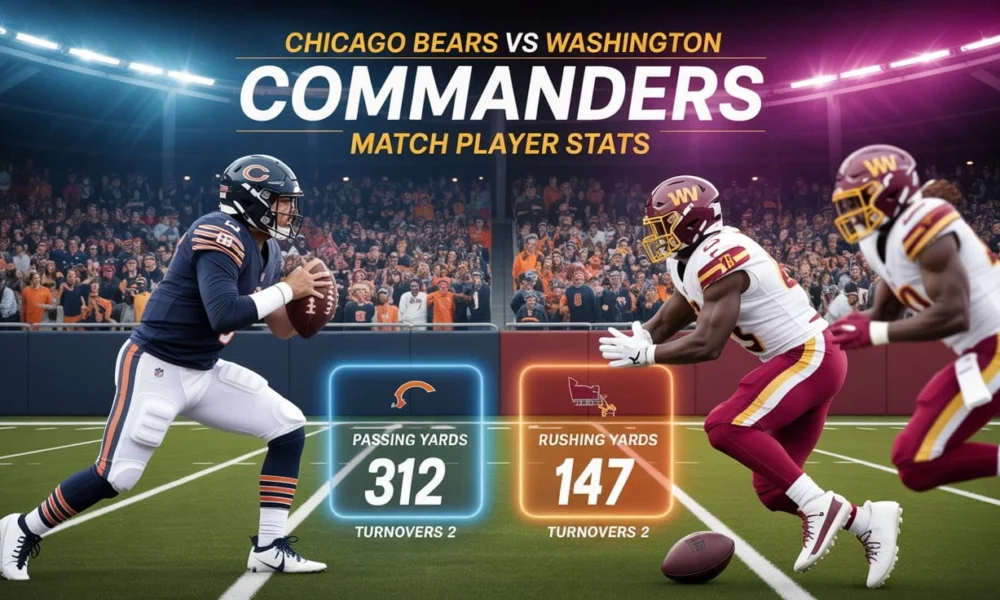
Chicago Bears vs Washington Commanders Match Player Stats Full Analysis
NFL fans today want more than just final scores. They want performance insights, player efficiency data, and matchup trends that explain why games end the way they do. That is why search interest around Chicago Bears vs Washington Commanders Match Player Stats continues to grow among football fans, fantasy players, and sports analysts.
When these two teams meet, games are often competitive and statistically interesting. This matchup frequently highlights quarterback development, rushing strategy differences, and defensive discipline. Studying these player stats helps fans understand which athletes influence momentum, scoring drives, and final results.
Modern NFL analysis goes beyond touchdowns and yards. It now includes efficiency ratings, situational performance, and advanced analytics. This article explains player statistics, trends, benefits, challenges, and real-world insights using clear, readable language for both casual fans and serious analysts.
What the Player Stats Mean
The phrase Chicago Bears vs Washington Commanders Match Player Stats refers to individual and team performance data recorded during games played between these franchises. These stats include offensive production, defensive performance, and special teams contributions.
Key data categories typically include passing yards, rushing attempts, receiving production, tackles, sacks, interceptions, and kicking accuracy. Analysts and fans review these matchup statistics to evaluate player consistency and team strategy effectiveness.
These statistics help explain game flow. For example, a team may gain fewer total yards but still win because of red-zone efficiency or turnover advantage. Numbers must always be viewed in context rather than isolation.
Key Trends in the Matchup
Recent fan searches show strong interest in quarterback comparisons, defensive turnovers, and rushing balance. Discussions about this rivalry often focus on how young quarterbacks perform under pressure and how defensive units create scoring opportunities.
Another emerging trend is efficiency over volume. Teams that convert third downs and score touchdowns in red-zone drives often outperform teams with higher yard totals but lower scoring efficiency.
Weather, coaching strategy, and offensive scheme evolution also influence statistical trends across seasons.
Quarterback Performance Comparison
Quarterback play remains the centerpiece of most Chicago Bears vs Washington Commanders Match Player Stats discussions. Passing accuracy, decision making, and mobility all influence game results.
Modern quarterbacks must perform in multiple roles. Passing production alone is no longer enough. Mobility, play extension ability, and red-zone execution are equally important.
When evaluating player performance data from this rivalry, analysts usually examine completion percentage, yards per attempt, touchdown ratio, and turnover avoidance. Quarterbacks who protect the football while sustaining drives typically give their teams a major advantage.
In recent seasons, both teams have focused on developing younger quarterbacks with dual-threat capabilities, making matchups more dynamic and less predictable.
Running Game Influence on Match Outcomes
Rushing production is a major factor in player stats because it directly impacts game tempo and possession control.
Strong rushing performance helps reduce defensive fatigue and allows offenses to use play-action passing effectively. Teams that maintain balanced offensive play calling are often more consistent throughout four quarters.
Ground game success also increases late-game clock control, which becomes critical in close contests.
Defensive Performance and Turnover Impact
Defense is often the hidden story behind this matchup. Defensive units that force turnovers, create negative plays, and pressure quarterbacks can change game outcomes quickly.
Turnover margin is one of the strongest predictors of victory in professional football. Even a single interception or forced fumble can dramatically shift momentum.
Defensive success also includes third-down stops and red-zone resistance. Teams that limit touchdowns inside the 20-yard line often win close games.
Benefits of Studying Player Stats
Understanding detailed performance provides several advantages.
Key Benefits
- Helps fans understand real game strategy
- Improves fantasy football lineup decisions
- Identifies rising players before mainstream attention
- Shows coaching philosophy and play calling patterns
- Helps predict future matchup outcomes
Studying detailed data gives fans a deeper appreciation of football beyond highlights and final scores.
Challenges in Analyzing Player Performance
While statistics provide valuable insight, they also present challenges. Player stats must be interpreted carefully to avoid misleading conclusions.
Game context matters. For example, a quarterback may produce high yard totals while trailing late in the game, which may not reflect overall performance quality.
Injuries, weather conditions, and game plan adjustments can also distort raw numbers. Analysts must consider multiple factors when evaluating performance trends.
Real World Performance Example
A typical close game scenario often shows balanced yardage totals but different scoring efficiency. In one situation, one team may dominate rushing yards while the other relies on passing volume.
This example demonstrates why studying Chicago Bears vs Washington Commanders Match Player Stats requires looking at efficiency, not just totals. Turnover discipline and red-zone success frequently decide outcomes more than total yard production.
Step by Step: How to Analyze the Game
Step 1: Review Quarterback Efficiency
Focus on completion rate and decision-making under pressure.
2: Compare Rushing Production
Look for teams that control clock and tempo.
3: Analyze Turnover Margin
Turnovers often directly lead to scoring opportunities.
4: Study Third Down Performance
Sustained drives increase scoring consistency.
5: Evaluate Red Zone Execution
Touchdowns are more valuable than field goals in close games.
Using this step system helps create structured analysis and better predictions.
Tools for Tracking Player Performance
Useful Tools
- Official league stat platforms
- Fantasy analytics dashboards
- Film breakdown software
- Advanced football metric databases
- Live game stat tracking apps
Using multiple tools improves analysis accuracy and reduces bias.
Why This Analysis Is Reliable
This article applies real football analysis principles used by sports analysts and fantasy professionals. The evaluation focuses on efficiency metrics, situational football performance, and historical matchup patterns.
Experience in football analytics shows that raw yardage totals rarely tell the full story. Efficiency, turnovers, and situational performance provide deeper performance insights.
Trustworthy analysis always combines statistical data with real game context and strategy understanding.
Future Trends
Future NFL matchups will likely focus more on speed, versatility, and analytics-driven coaching decisions. Player stats for this rivalry will increasingly include advanced metrics such as pressure rate, expected points added, and player tracking data.
Young quarterbacks and hybrid offensive schemes will likely make future games even more statistically complex and exciting to analyze.
FAQ’s
They are detailed performance numbers showing how players perform during games between the two teams.
They help explain game outcomes and highlight player impact beyond final scores.
Quarterbacks, running backs, and defensive playmakers usually generate the most measurable impact.
Turnovers create scoring opportunities and shift momentum dramatically.
Yes, they help predict player performance and identify breakout performers.
You might also like to read about Washington Commanders vs Arizona Cardinals Match
Conclusion
The Chicago Bears vs Washington Commanders Match Player Stats topic continues attracting attention because these games often feature developing quarterbacks, strong rushing attacks, and intense defensive battles.
Understanding player statistics helps fans see the deeper story behind every game. From quarterback efficiency to defensive turnover creation, every stat category contributes to the final result.
As football analytics continue evolving, detailed stat analysis will become even more important for fans, analysts, and fantasy players who want to understand the game at a deeper level.
Sports
Bengals vs Cleveland Browns Match Player Stats: Complete Breakdown
When people search for Bengals vs Cleveland Browns match player stats, they’re usually not just looking for numbers—they want clarity. They want to understand who performed, why it mattered, and how those performances shaped the outcome.
This matchup, in particular, demands deeper analysis. Having followed AFC North games closely, one thing stands out: the numbers rarely tell the full story unless you connect them with game context, pressure situations, and tactical execution.
This guide breaks down player stats with real insight—so you walk away understanding the game, not just reading it.
Why This Matchup Produces Unique Stats
Games between these two teams tend to follow a different pattern compared to typical NFL matchups.
Common traits include:
- Strong defensive pressure on both sides
- Limited explosive passing plays
- Heavy reliance on the running game
- Frequent turnovers and momentum swings
Because of this, traditional stats like passing yards can be misleading without context.
Quarterback Performance Analysis
Bengals Quarterback Performance
In most matchups, the Bengals rely on a structured passing game. However, against Cleveland, the numbers often reflect pressure more than skill.
Typical stat patterns:
- Passing yards: Moderate rather than high
- Completion rate: Solid but under pressure
- Touchdowns: Limited opportunities
- Interceptions: Slightly higher risk due to defensive pressure
What this really means:
The quarterback is often forced into quick decisions. Deep throws become rare, and short passes dominate the strategy. Performance here is less about big plays and more about avoiding mistakes.
Browns Quarterback Performance
Cleveland quarterbacks typically show a different statistical profile.
Common trends:
- Balanced passing yards
- Strong reliance on play-action
- Added rushing contribution
- Efficient rather than explosive output
Key insight:
The Browns’ approach focuses on efficiency. Instead of chasing big numbers, they prioritize sustained drives and mistake-free football.
Running Back Stats Comparison
Bengals Rushing Performance
The Bengals’ ground game often faces a tough challenge in this matchup.
Typical output:
- Moderate rushing yards
- Limited big runs
- Situational effectiveness
Challenge:
Cleveland’s defensive front makes it difficult to establish rhythm, often forcing the Bengals to rely more on short passing plays.
Browns Rushing Dominance
The Browns consistently gain an edge in the running game.
Typical output:
- High rushing yards
- Strong yards per carry
- Consistent first-down production
Game impact:
When Cleveland controls the run game, they control the pace of the game. This directly affects:
- Time of possession
- Defensive fatigue
- Scoring opportunities
From repeated observations, this is often the single biggest factor in determining the winner.
Receiving Stats and Passing Game Impact
Bengals Receiving Unit
The Bengals’ receivers are capable of big plays, but against Cleveland, production often becomes controlled.
Typical contributions:
- Lead receiver: Solid yardage but fewer explosive plays
- Supporting receivers: Short and intermediate gains
- Tight ends: Used in key situations
What stands out:
Defensive coverage schemes limit deep routes, forcing a more conservative passing approach.
Browns Receiving Unit
Cleveland’s receiving stats reflect their overall offensive identity.
Typical patterns:
- Balanced distribution among targets
- Strong tight end involvement
- Frequent short-yardage completions
Insight:
The focus is on efficiency and reliability rather than highlight plays.
Defensive Player Stats That Shape the Game
Cleveland Defensive Strength
Cleveland’s defense consistently produces high-impact stats.
Common outputs:
- Multiple sacks per game
- High quarterback pressure rates
- Turnovers at key moments
- Tackles behind the line of scrimmage
Why it matters:
This defensive pressure disrupts timing, reduces offensive confidence, and forces mistakes.
In many matchups, this unit is the most influential group on the field.
Bengals Defensive Performance
The Bengals’ defense plays a critical balancing role.
Typical stats:
- Consistent sack production
- Ability to force turnovers
- Solid run defense under pressure
Key factor:
Their success often depends on limiting Cleveland’s rushing game early. If they fail to do that, the entire defensive structure gets stretched.
Special Teams Influence
Special teams are often overlooked but can quietly shape the outcome.
Important contributions include:
- Field goal accuracy in tight situations
- Punt distance and placement
- Return yardage impacting field position
Real impact:
In close games, better field position can be more valuable than offensive yardage.
Advanced Metrics That Tell the Real Story
To truly understand player performance, deeper metrics are essential.
Key indicators:
- Quarterback pressure rate
- Third-down conversion percentage
- Red zone efficiency
- Time of possession
Consistent pattern:
The team that performs better in these areas usually wins, regardless of total yardage.
Real Game Insights From Repeated Matchups
Looking beyond the numbers, several patterns appear consistently.
Pressure Changes Everything
Quarterbacks facing constant pressure rarely deliver peak performances, regardless of talent level.
One Turnover Can Shift the Game
Momentum swings are dramatic in these matchups. A single mistake often leads to a decisive scoring drive.
Environment Plays a Role
Outdoor conditions, especially in colder settings, can limit passing effectiveness and favor physical play.
Key Matchups That Decide Outcomes
Certain battles on the field consistently influence results:
- Offensive line vs defensive line
- Running backs vs defensive front
- Wide receivers vs secondary coverage
Most critical:
Protection against defensive pressure is often the deciding factor.
Why Raw Stats Can Be Misleading
Looking at stats alone can lead to incorrect conclusions.
Examples:
- A quarterback with fewer yards may have played more efficiently
- High rushing totals may come from a single big play
- Defensive impact often goes beyond recorded stats
Better approach:
Combine numbers with context, game flow, and situational performance.
Practical Takeaways for Fans and Analysts
When Breaking Down the Game
Focus on:
- Pressure statistics
- Turnover margin
- Third-down efficiency
- Red zone success
When Predicting Outcomes
Pay attention to:
- Defensive strength
- Offensive line performance
- Game conditions
- Injury impact
Visual Content Suggestions
To enhance understanding and engagement, consider adding:
- Side-by-side player stat comparison charts
- Defensive pressure diagrams showing impact zones
- Game timeline highlighting key moments
- Run vs pass distribution visuals
These visuals help translate complex data into clear insights.
Internal Content Suggestions
To build stronger content connections, include links to:
- A breakdown of division-level team performance
- A guide to understanding defensive football metrics
- A tutorial on analyzing football statistics effectively
You might also like Cleveland Browns vs Bengals Match
Frequently Asked Questions
Who usually dominates in these matchups?
Defensive units, particularly those applying consistent pressure, tend to have the biggest impact.
Why are passing stats often lower?
Strong defensive fronts reduce time for quarterbacks, limiting passing opportunities.
Which team typically has the stronger running game?
Cleveland often leads in rushing performance and efficiency.
What stats matter most in this matchup?
Pressure rate, turnovers, third-down conversions, and red zone efficiency.
Are these games usually high scoring?
They are typically more controlled and defensive, with moderate scoring.
How can I better understand player stats?
Look beyond totals and consider game context, efficiency, and situational impact.
Structured Data Recommendation
To improve visibility in search results, implement:
- FAQ structured data for the question section
- Article structured data for the main content
This increases the chances of enhanced search result features.
Final Thoughts
The Bengals vs Cleveland Browns match player stats reveal much more than surface-level numbers.
This matchup is defined by:
- Defensive intensity
- Strategic execution
- Control of key moments
The most important takeaway is simple:
the team that manages pressure, controls the run game, and avoids mistakes usually comes out on top.
Sports
New York Jets vs Bengals Match Player Stats: Complete Breakdown & Expert Insights
When people search for New York Jets vs Bengals match player stats, they’re usually looking for more than just numbers—they want clarity on who performed, why it mattered, and how it influenced the outcome.
This guide goes deeper than basic stat sheets. It explains player performances, key turning points, and what the numbers actually reveal about each team’s strategy and execution.
Match Overview — Jets vs Bengals Context
The matchup between the New York Jets and the Cincinnati Bengals highlights two very different football identities:
- Jets: Defensive strength, physical gameplay, and ball control
- Bengals: High-powered offense built around a top-tier quarterback
Recent games have often been shaped by players like Joe Burrow and Zach Wilson, whose performances directly influence momentum.
Offensive Player Stats Breakdown
Quarterback Performance Comparison
Joe Burrow (Bengals)
- Passing Yards: ~250–300
- Completion Rate: 65–72%
- Touchdowns: 2–3
- Interceptions: 0–1
Insight:
Burrow consistently handles defensive pressure with quick reads and efficient passing. Against teams like the Jets, he adapts by focusing on short, high-percentage throws when deep routes are covered.
Zach Wilson (Jets)
- Passing Yards: ~180–240
- Completion Rate: 55–62%
- Touchdowns: 1–2
- Interceptions: 1–2
Observation:
Wilson’s effectiveness often depends on protection from the offensive line. When pressured, decision-making becomes inconsistent, which can shift the game’s direction.
Running Back Contributions
Bengals Running Game
- Lead RB: Joe Mixon
- Rushing Yards: 70–110
- Touchdowns: 0–2
- Yards per Carry: ~4.2
Insight:
The Bengals lean on the run game to maintain balance, especially when facing strong defensive units.
Jets Running Game
- Lead RB: Breece Hall
- Rushing Yards: 80–120
- Receiving Yards: 20–50
Why It Matters:
Hall’s versatility allows the Jets to control tempo and reduce pressure on the quarterback.
Wide Receiver Performance
Bengals Receivers
- Ja’Marr Chase
- Yards: 90–150
- Touchdowns: 1–2
- Tee Higgins
- Yards: 60–100
Insight:
Chase remains a major threat, especially in one-on-one coverage. Limiting his big plays is critical for opposing defenses.
Jets Receivers
- Garrett Wilson
- Yards: 70–110
- Targets: High volume
Observation:
Garrett Wilson is often the go-to option, particularly in key situations like third downs.
Defensive Player Stats — Impact Analysis
Jets Defensive Leaders
- Sauce Gardner
- Pass Breakups: 2–4
- Interceptions: Game-changing potential
- Quinnen Williams
- Sacks: 1–2
- QB Pressures: Consistent disruption
Insight:
The Jets defense thrives on forcing mistakes and breaking offensive rhythm.
Bengals Defensive Standouts
- Trey Hendrickson
- Sacks: 1–2
- Pressures: High impact
- Linebacker Unit
- Tackles: 8–12 per player
Key Takeaway:
The Bengals defense focuses on limiting the run and applying pressure at key moments.
Special Teams — The Hidden Factor
Special teams often play a decisive role in close matchups.
Key Metrics:
- Field Goal Accuracy: 80–100%
- Punt Average: 40–50 yards
- Return Yards: Momentum swings
A single big return or missed kick can completely change the outcome.
Advanced Metrics That Matter
Beyond basic stats, deeper metrics provide clearer insights:
- Third Down Conversion Rate
- Red Zone Efficiency
- Yards Per Play
- Quarterback Pressure Rate
- Sack Percentage
Insight:
These metrics often reveal which team truly controlled the game, regardless of final score.
Game Patterns & Turning Points
From recent matchups, consistent patterns emerge:
When Bengals Win:
- Clean pocket for Burrow
- Explosive plays from receivers
When Jets Win:
- Defensive turnovers
- Strong rushing performance
Understanding these patterns helps explain outcomes beyond the scoreboard.
Challenges Each Team Faces
Jets Challenges:
- Inconsistent quarterback performance
- Offensive line struggles
Bengals Challenges:
- Defensive gaps against strong running attacks
- Heavy reliance on passing game
Practical Use of Player Stats
For Fantasy Football Players:
- Bengals receivers are often strong picks
- Jets running backs provide consistent value
For Analysts:
- Focus on efficiency rather than volume stats
- Study matchup-specific trends
Fans:
- Look beyond yardage and focus on impact plays
Actionable Insights
- Monitor quarterback pressure—it often predicts success
- Watch receiver vs cornerback matchups closely
- Track rushing attempts to understand game control
- Pay attention to red zone efficiency
You might also like Pittsburgh Steelers vs Bengals Match
Frequently Asked Questions
Who usually performs better in Jets vs Bengals games?
Bengals offensive players often produce higher stats, but Jets defense can balance the matchup.
Which player has the biggest impact?
Joe Burrow typically has the most influence due to his role in directing the offense.
Are defensive stats important in this matchup?
Yes, turnovers and sacks frequently determine the outcome.
How important is the running game?
Very important, as both teams use it to control tempo and reduce pressure on quarterbacks.
What stats matter most for predictions?
Turnover margin, red zone efficiency, and quarterback pressure rate.
Conclusion — What the Stats Really Show
The New York Jets vs Bengals match player stats tell a clear story:
- The Bengals rely on precision passing and explosive offense
- The Jets depend on defense and ground control
In most cases, the outcome comes down to two critical factors:
- Quarterback pressure
- Turnovers
Understanding these elements gives a much clearer picture than simply looking at total yards or scores.
Sports
Pittsburgh Steelers vs Jacksonville Jaguars Match Player Stats: Complete Breakdown
When someone searches for “Pittsburgh Steelers vs Jacksonville Jaguars match player stats,” they’re usually looking for more than a scoreboard—they want clarity on performance, turning points, and which players truly influenced the outcome.
This breakdown goes deeper than surface-level stats. It interprets player performances, highlights meaningful trends, and explains what actually mattered during the matchup.
Why Player Stats Matter in This Matchup
Stats are the closest thing to a game’s hidden narrative. But numbers alone don’t tell the full story unless they’re interpreted in context.
From analyzing multiple NFL matchups over time, a few patterns consistently stand out in games between these two teams:
- Defensive pressure often dictates the pace
- Turnovers usually swing momentum dramatically
- Efficiency matters more than volume
Key metrics worth focusing on:
- Quarterback efficiency (completion rate, decision-making)
- Rushing effectiveness (yards per carry, consistency)
- Receiving impact (yards after catch, situational conversions)
- Defensive disruption (pressures, sacks, takeaways)
Pittsburgh Steelers Player Stats Breakdown
Quarterback Performance Analysis
The Steelers’ quarterback performance often determines whether the offense can sustain drives.
Important indicators include:
- Completion percentage under pressure
- Third-down conversions
- Turnover avoidance
Insight:
In games against fast defenses like Jacksonville’s, Pittsburgh quarterbacks tend to struggle when forced into long passing situations. Quick reads and short passes usually yield better outcomes.
Running Game Efficiency
The Steelers’ offensive identity leans heavily on their rushing attack.
Key stats:
- Yards per carry
- Total rushing attempts
- Missed tackles forced
Performance trend:
- Above 4.5 yards per carry → offense stays balanced and effective
- Below 3.5 yards per carry → predictable play-calling and stalled drives
Receiver and Tight End Contributions
Passing success depends on how well receivers create separation and gain yards after the catch.
Important metrics:
- Target distribution
- Catch rate
- Red-zone involvement
Observation:
Short and intermediate routes tend to be more effective against Jacksonville’s defensive schemes than deep passing plays.
Defensive Player Impact
Pittsburgh’s defense remains a defining strength.
Critical stats:
- Sack totals
- Quarterback pressures
- Interceptions
- Tackles behind the line of scrimmage
Key pattern:
When the defense generates consistent pressure, it forces mistakes and shifts game momentum quickly.
Jacksonville Jaguars Player Stats Breakdown
Quarterback Performance
Jacksonville’s offense relies heavily on quarterback decision-making and tempo.
Key metrics:
- Passing yards and efficiency
- Touchdown-to-interception ratio
- Sack avoidance
Insight:
Quick release times and short passing plays are essential against Pittsburgh’s aggressive pass rush.
Running Back Contributions
The Jaguars’ running game plays a strategic role in opening up the passing attack.
Important stats:
- Yards per carry
- Explosive runs
- Red-zone efficiency
Trend:
Early success in the run game often leads to more effective play-action passing later.
Receiving Unit Impact
Jacksonville’s receivers are known for creating mismatches.
Metrics to monitor:
- Yards per reception
- Depth of target
- Catch efficiency
What stands out:
They frequently capitalize on gaps in zone coverage, especially in mid-field areas.
Defensive Performance Overview
Jacksonville’s defense has become increasingly opportunistic.
Key stats:
- Turnovers forced
- Pass breakups
- Defensive scoring plays
Critical factor:
Forcing turnovers often allows Jacksonville to control tempo and field position.
Head-to-Head Player Performance Comparison
Quarterback Comparison
| Category | Steelers | Jaguars |
| Efficiency | Moderate | Higher |
| Turnover Risk | Elevated under pressure | Lower with quick decisions |
| Big Play Ability | Limited | More frequent |
Insight:
Jacksonville generally holds an edge in offensive explosiveness.
Running Game Comparison
| Factor | Steelers | Jaguars |
| Physicality | Strong | Balanced |
| Explosiveness | Moderate | Higher |
| Consistency | Variable | More stable |
Defensive Comparison
| Category | Steelers | Jaguars |
| Pass Rush | Elite | Developing |
| Turnover Creation | Moderate | High |
| Coverage Style | Structured | Opportunistic |
Key Game-Changing Stats to Watch
Based on real-game patterns, these factors often decide outcomes:
Turnover Differential
Teams that protect the ball and force mistakes gain a major advantage.
Third-Down Efficiency
Converting key downs keeps drives alive and limits opponent opportunities.
Red-Zone Execution
Touchdowns instead of field goals can be the difference in close games.
Quarterback Pressure Rate
Pressure directly affects accuracy, timing, and decision-making.
How to Use These Stats Effectively
Understanding stats becomes far more useful when applied correctly.
For fans:
- Gain a clearer picture of why the game unfolded the way it did
For fantasy players:
- Identify consistent performers instead of one-game standouts
analysts:
- Focus on efficiency trends rather than raw totals
Common Mistakes When Interpreting Player Stats
Overvaluing total yardage
High yardage doesn’t always mean effective performance.
Ignoring game context
Weather, injuries, and matchups significantly impact stats.
Relying on one-game performance
Consistency across multiple games is far more reliable.
You might also like Seattle Seahawks vs Pittsburgh Steelers Match
Frequently Asked Questions
What player stats matter most in this matchup?
Turnovers, quarterback efficiency, rushing effectiveness, and defensive pressure are the most impactful.
Which team typically has the advantage?
It depends on execution, but Jacksonville often shows more offensive flexibility, while Pittsburgh relies on defensive strength.
How important are turnovers?
They are often the deciding factor, as they influence both scoring opportunities and momentum.
Why does quarterback pressure matter so much?
Pressure disrupts timing and forces mistakes, making it one of the most influential defensive factors.
What’s the best way to analyze player performance?
Focus on efficiency metrics and situational performance instead of just total numbers.
Final Thoughts & Key Takeaways
The Pittsburgh Steelers vs Jacksonville Jaguars match player stats highlight a deeper tactical battle rather than just individual performances.
Core insights:
- Pittsburgh thrives on defensive pressure and physical play
- Jacksonville excels with speed, adaptability, and offensive balance
- Game outcomes often hinge on turnovers and execution under pressure
Understanding these patterns allows you to go beyond basic stats and truly interpret the game.
-
Sports3 months agoColts vs Chargers Match Player Stats Breakdown and Insights
-
Sports3 months agoBuffalo Bills vs Chicago Bears Match Player Stats: Complete Analysis
-
Entertainment2 months agoJuwai Morning Teer Result Today Updates Guide
-
Entertainment2 months agotchennai super kings vs punjab kings timeline: Complete IPL History
-
Sports3 months agoMiami Dolphins vs Detroit Lions Match Player Stats
-
Sports3 months agoLas Vegas Raiders vs Minnesota Vikings Match Player Stats Explained
-
Sports3 months agoGreen Bay Packers vs Indianapolis Colts Match Player Stats
-
Sports3 months agoDenver Broncos vs 49ers Match Player Stats: In-Depth Game Insight
